

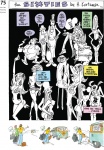
Michel Choquette was an editor at National Lampoon, where, as he explains, he was instrumental in the creation of the American Heavy Metal, when he was approached by legendary Rolling Stone editor Jann Wenner about creating a history of the 1960s in comics. In this interview with ICv2, Choquette explains the gestation of the project, the book’s title, and the long, tortuous path to publication. For more on about this fascinating project, see ICv2’s article, The Sunday Funnies
.
What was the origin of The Someday Funnies?
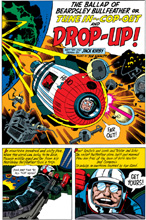
Originally it was around Christmas of 1970 when [Rolling Stone’s]JannWenner approached me when I was an editor at the National Lampoon, and because I’d done comics and things like that. He asked me whether I would put together, as an editor, a history of the 1960s in comic book form—just an eclectic sort of effort, a suggestion of events of the 60s, the personalities, the bands, the music, politics, stuff like that. I worked on this in 71 and 72 and I went to see traditional people at Marvel and DC people, MAD Magazine people and underground people in San Francisco and New York and everything, and I also got European people to contribute. People like Goscinny who does Asterix and the Lucky Luke guys and all that. I also went to other countries like Holland, mostly for the underground scene there, and Belgium and Italy and Germany.
Eventually what happened is I got a whole bunch of strips together and by then Jann and I were thinking we would expand this into a whole book and delay the supplement so that it would come out sort of as a preview for the book. Just a bit before his book was published on his Straight Arrow line of books. What happened is Jann backed out of it. He decided that he didn’t feel it was right or really what he wanted, so in late 1972 after working on it for several years, I was left hanging with all these promises to all these guys that they would get something for haven given me the strip and I was stuck.
I tried to find private money to put the book out privately, and I got pretty close to raising it here in Canada and in New York. After two or three years of that, I had to put the book aside and put everything in a trunk and get on with things.
He sent the interview [to] Bob Levin, who, based on that, gave me a call and came out and spent a few days with me. Then I spent a whole year answering his questions by email. I have a six-inch thick pile of emails with him in which he had me tell him the whole story. He looked through all the files and artwork. Eventually his article came out in August 2009 and that’s the one we’re talking about here. That was Issue 299 of the Comics Journal. It’s a 40- or 50-page article—pretty informative.
And because of this, publisher’s got interested. Obviously Fantagraphics, who owns the Comics Journal were interested, but there’s just too many people involved and too many royalties to pay for all these people. Gary Groth just couldn’t afford it, so I was approached by Charles Kochman. Jay Lynch and Denis Kitchen and some of the other people who are in the book had tipped him off that he should come and take a look at this. So Charlie came up to Montreal a year ago, around the time the article was coming out, and saw the material I had. That’s when we made an arrangement, and so the book is coming out in the fall of 2011.
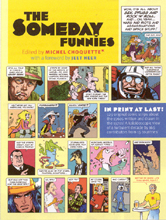
We’ve designed a modern cover for it. We’re looking at options, Charlie and I, but I’m designing the book you see here. So even though the strips themselves are pretty much as they were, except they’ve had to be colored professionally. All I had was old color guides and Photostats, but they’ve been professionally colored by my graphics crew here in Montreal and they’re ready to go. But there’s a preface to write and intro, Jeet Heer has written a forward to it, and an index, and all the contributor notes, and pages and pages of notes, bio notes, explanation of events of the 60s. A lot of people today may not know some of the things. They may know about the Kennedy assassination and the Vietnam War, but they may not know about the student riots in France, [or] exactly who Timothy Leary was, etc. So, Biographical notes as well as notes on the strips in the back of the book.
My entire advance is going to them. I’ll only make money if the book recoups, but I owe it to them after all these years- a third of the century. But I’m happy to say I’ve reached about three quarters of them and that I haven’t had one refusal yet. So it looks like as long as I can reach everybody, the book will be pretty much as I envisioned it, and Charlie and I envisioned it to be at the moment.
Can you tell us more about the art/cover?
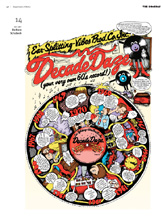
So the old cover of the book was not right for today, but it’s going to be prominently displayed in the book. It may be on the case, on the hard cover and not be on the dust jacket. And it will certainly be run inside the book. But at the time the dummy was done with that cover, I was no longer doing it for Rolling Stone, I was doing it for Harper & Row.
It started as a Rolling Stone project and my relationship with them ended all right because they backed out of it, it’s not like I didn’t deliver. They freed me to do what I wanted to do, but of course, I have to pay the guys. So that’s the situation.
Tell us something about the strips themselves. Has this material been seen before?
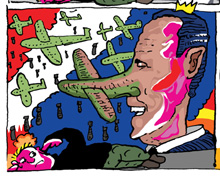
The book is being publicized as containing strips that have never been seen before, and I think that’s the case for 95% of them. It’s a time capsule of how they were working at the time. So it’s not only history of the 1960, but it shows what the artists were doing at the time. It’s interesting because their styles have changed in many cases, and of course, about 50 of the artists are dead.
So even on the strips the Comics Journal published, they hadn’t previously been seen in color, so that would be something different wouldn’t it?
They ran them in color, but they were just some scans of the old hand-colored color guides from people at Marvel at the time like Mimi Golden, Marie Severin, or the artists themselves. They had not really been properly colored yet. Those were just guides. They used to give me the black and white artwork, and in those days, they would do a Photostat of it and hand color it in Doctor Martin inks or markers or whatever and then the color separators would follow these colors and really get them ready for printing. But now with Photoshop, it’s done differently. You go from the color guide and you do it in Photoshop and go straight to printing that way. So the color is going to be of much better quality than it was in the Comics Journal.
What was your goal in assembling this, was it historical, artistic, were you trying to get a capsule in the comics format, or was it also to collect all these different art styles?
Well it was all of those. Originally it was simply a commission. Wenner asked me to put together something that gives an eclectic, kaleidoscopic view of some of the events of the 60s, but mix the genres. We approached it that way, and then I saw there was a lot of interest. There was so much that happened in the 60s, and then I started getting interested in the European guys and this and that.
My first language is French. I grew up reading a few languages so of course I was interested in European comics and this and that. I was the one that was largely responsible for having set up the connection between National Lampoon and the guys that were doing Metal Hurlant, the Heavy Metal magazine stuff where the French guys started having their stuff shown in the States. Those things hadn’t happened then yet
Moebius and Druillet and all those guys?
Those are all guys I knew and met in Paris. My idea was to have people of many different genres come together in the book. That was as interesting for me as telling the story of the 1960s. It was two-fold thing. Both those things were happening.
I also wanted to use some people who normally aren’t associated with comics, like Tom Wolfe doing some drawings for me, Fellini did a comic strip for me, William Burroughs wrote one for me, illustrated by Malcolm McNeill. I also had Frank Zappa write something for me that someone else illustrated. And some fine arts guys like Red Grooms and things like that. A lot of other people I was trying to get, but in the end I hadn’t gotten. I went to see people like Dali.
It was getting more and more exciting. It was a shame it didn’t come out with Harper & Row because Cass Canfield himself was ecstatic about the book. I already had two or three European publishers who were definitely on board as long as my main U.S. publisher was on board.
It was all a marketing thing. The marketing guys were afraid of the book.
Does it have sexy stuff in it?
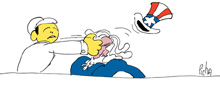
Yes, there’s a bit of that in it, but it’s not overtly that way. There’s not much of it. What I found in many cases was a lot of these people who normally do much lighter genre stuff—take for example Sergio Aragones—did something on the murder of all the students at 1968 Mexican Olympics. A lot of these people let their hair down to do something that they normally wouldn’t do in the regular comics world. So that was an interesting thing that these people were doing something that they hadn’t done before.
Where did the title come from?
On the original cover I commissioned a painting of a middle class American family watching television where Ruby’s shooting Oswald, with the father saying, "Someday we’ll look back at all this and laugh." So it’s a spoof on the Sunday funnies, of course. And it’s called "The Someday Funnies." The title is of its era in a way. I was at the Lampoon and into satire and all that, so that’s the title. So that won’t be the cover, but that old cover will be shown.
You walked through the history, then there was a 25-30 year gap in there. What was going on then?
I didn’t do anything about it. See I worked three years doing the strips and four years trying to raise the money. After seven years it was almost a full time concern. I just couldn’t deal with it anymore. Something told me to let it lie for a while and think again later on. So I kept the artwork very safe, partly in London and partly here [in New York]. I came back to home town, Montreal, because I was working on some projects. By then I had moved away from Lampoon to work on this project. I stayed in Montreal because I was working on a film project. Then I got involved with the National Film Board making documentaries for several years. I made a few documentaries for them and wrote some scripts for other things. Then I ended up teaching screen writing at McGill University and then at Concordia University. I’m still at Concordia University after 25 years teaching screen writing. Then I got involved in a fashion business because my girlfriend was a fashion designer. We had a showroom in New York and doing high end children’s clothes that she designed and we sold to all the major department stores in the States. And then with the Chinese competition, we got out of that. Somehow I kept teaching all this time, and a few of the songs I wrote were successful here in French Canada, but nothing at all on the book until this article came out. And then it’s been only the book, except for teaching, since then.
I want to lay my egg--37 years too late, but it’s going to be nice when it’s out.